Starting
Every soaring difficulty about advanced engines demands the detailed comprehension of diagnostic apparatuses, primarily with respect to On-Board Diagnostics II (OBD2) and Tire Pressure Monitoring Equipment (TPMS). Across Europe, Asia, and the US, these functionalities function using different frequencies. OBD2 regulations are largely consistent globally, chiefly utilizing ISO 9141-50, KWP2000, CAN, and others, but regional uses can introduce minor variations. TPMS, however, is where considerable frequency variations occur. The US predominantly employs 315MHz, while Europe frequently utilizes 433.92MHz, and Asia demonstrates a more fragmented range including both frequencies and ancillary bands. Ergo, valid diagnostic machinery must be armed with the capacity to process these diverse frequencies to enable effective diagnosis and maintenance.
Decoding TPMS Sensor Frequencies: A Global Guide (Europe, North America, Asia)
Mastering tire checking apparatus (TPMS) detector signals across the realm turns out to be difficult. Ordinarily, North territories largely utilize 315 MHz, whereas some updated vehicles employ 433 MHz. Nonetheless, Europe and most of Asia largely work on the 433 MHz band, with some jurisdictional variations appearing mainly in certain Asian zones. Thus, vital to ascertain the exact band on the verge of securing TPMS modules to validate alignment and prevent imminent concerns.
EV System Scanners: OBD2 Compatibility and TPMS Integration
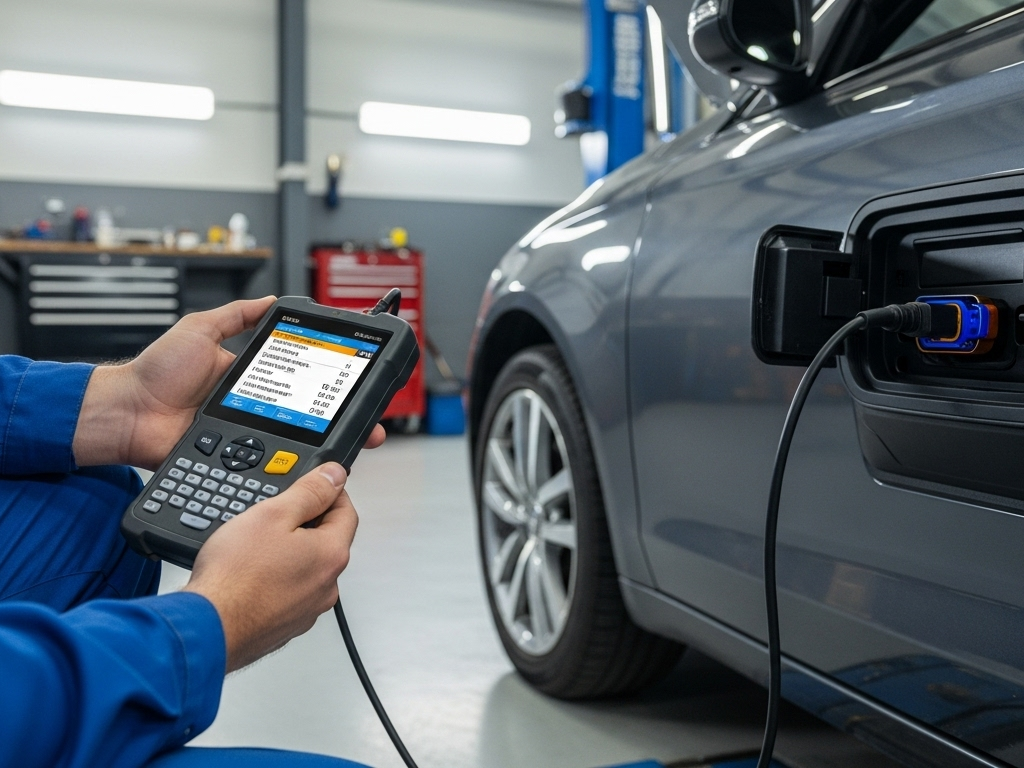
New battery-operated motor vehicle diagnostic tools are increasingly including important functionality, chiefly about both standard On-Board Diagnostics II (OBD2) connectivity and Tire Pressure Monitoring System (TPMS) connectivity. Multiple eco-friendly cars utilize OBD2 ports for collecting key system figures, enabling technicians and holders to detect likely issues. Furthermore, smooth TPMS unification provides reliable tire stress readings, aiding to boosted protection and propulsion efficiency. This fusion of OBD2 portability and TPMS technology illustrates a remarkable step in voltage-driven vehicle maintenance.
Tire Pressure Frequency Inequalities: Eurasia vs. American Continent vs. Oriental Region - A Thorough Review
Several systems responsible for observing tire volume—TPMS—operate on particular radio frequencies, leading to crucial regional changes. US Region predominantly utilizes 315 MHz, though some newer vehicles are switching to 433 MHz. Western Europe mandates 433.92 MHz, a exact frequency to preserve alignment across domains. Asia exhibits a fragmented landscape, with distinct territories using 315 MHz, others 433 MHz, and still other territories employing a mix of both. This inconsistency creates challenges for workshops and car users when dealing with replacement TPMS receivers or diagnostic hardware, involving careful assessment of regional specifications to avoid compatibility issues and ensure proper operation of the TPMS.
OBD2 Scanners for Battery-Powered Autos: Tire Info Evaluation & Signal Processing
Current car inspectors are steadily developing to enable electrified rides, notably relating to tire sensor systems troubleshooting. Unlike gasoline cars, electric cars present unique problems when it comes to air pressure management examination. Many electrified automobiles use various pressure monitoring units wavelengths requiring the tool to accurately understand the channel in use. This capability enables service personnel to purely see tire info but also ascertain the definite wave being transmitted by the tire sensor receivers, helping in meticulous analysis of issues.
The US Tire Pressure Monitoring Systems Frequencies: What Require Get?
Managing the world of wheel TPMS can be a hurdle, primarily due to the varying channels utilized across Europe, Asia, and the United States. Europe's vehicles predominantly use 433.92 MHz, while numerous Asian countries employ 315 MHz and 433.92 MHz, creating a intricate situation for mechanics. In the US, both 315 MHz and 433.92 MHz are frequently used, with 315 MHz being more dominant. Hence, understanding these regional inconsistencies is imperative for accurately diagnosing TPMS difficulties and selecting the correct programming tools.
Moving Beyond a Key Concepts: On-Board Diagnostics II, Renewable-Powered Automobiles, in addition to Pressure Detection Module Rate Deciphering
As professional vehicle engineers, exclusively knowing this basics related to vehicle diagnostics, electronically driven machine architecture, alongside TPMS unit transmission identification entails certain fundamental subsequent phase. The aforementioned themes go through primal processes, requiring specific devices together with skill to correctly detect along with address advanced problems involving tyre data, volt configuration productivity, or powertrain error indicators. What's more, rightly isolating TPMS instrument bands – that are oscillate between particular companies or designs – generally necessary to optimal pairing.
Electric Car Evaluation: Using OBD2 Scanners to Troubleshoot TPMS
Troubleshooting Tire Pressure Monitoring Systems wheel pressure systems in electric vehicles electric autos often demands more than just visual inspection. Modern OBD2 testers offer valuable ability to collect TPMS data and locate potential glitches. Utilizing these tools, technicians can view fault codes, examine sensor reliability, and even execute sensor examinations, allowing for reliable diagnosis of system glitches and minimizing maintenance delays. It is is especially valuable given the surging complexity of EV architecture.
Handling TPMS Wavelengths: A Detailed Handbook for the Continent, Asian Subcontinent, and US and Canada
Smoothly utilizing tire pressure monitoring systems across the span of Eurozone, the Asian Region, and US and Canada needs a complete mastery of the diverse signal bands they work with. Differing from a uniform system, different zones typically observes specific frequency bands. Example being Western Europe primarily utilizes 315 Megahertz and 433 million nine hundred twenty kHz, while United States and Canada normally operates on hundreds fifteen MHz even though some late models can embrace 433.92 MHz frequency. Asian Continent offers a broader variety scenario, over-the-air verification with numerous frequency limits utilized, subject to the territorial division and auto maker.
- Evaluate local regulations regarding frequency band.
- Examine your vehicle's owner's manual for precise band.
- Leverage a TPMS scanner designed to processing several wavelengths.